


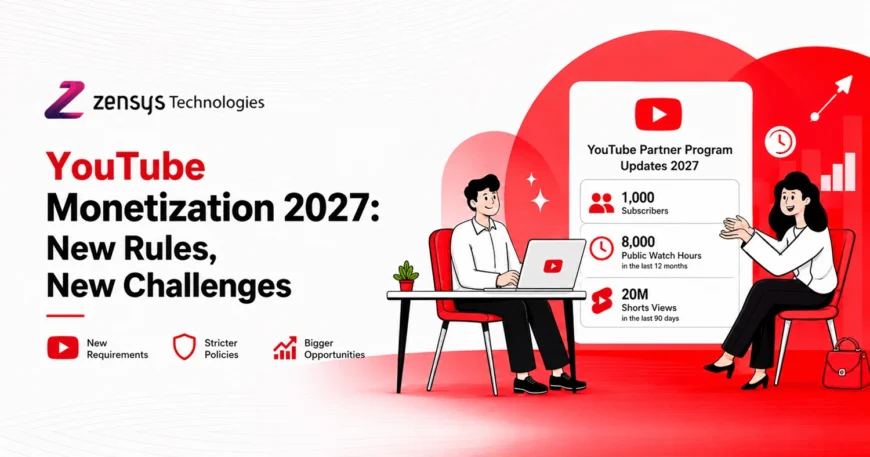
YouTube is preparing for significant changes to its YouTube Partner Program (YPP) starting February 1, 2027, creating new considerations for both new and existing creators.
The reported changes are expected to introduce higher eligibility requirements for new channels and a new activity threshold connected to Shorts revenue sharing for existing YPP creators.
For creators who depend on YouTube income, these changes could make consistent content creation, audience growth and Shorts performance more important than ever.
Zensys Technologies is closely following these developments to help creators and businesses understand what the changing YouTube monetization environment could mean for their digital growth strategy.
What Is Changing in the YouTube Partner Program?
YouTube’s Partner Program allows eligible creators to earn money through several monetization options, including:
- Watch Page advertising
- Shorts Feed advertising
- YouTube Premium revenue
- Channel memberships
- Super Chat
- Super Stickers
- Super Thanks
- Shopping and other creator monetization features
YouTube currently uses different eligibility thresholds depending on the monetization feature. Its official documentation currently lists 1,000 subscribers plus either 4,000 valid public watch hours in the previous 12 months or 10 million valid public Shorts views in the previous 90 days for full ad-revenue eligibility.
From February 1, 2027, reported updates indicate that the entry requirements for new creators will become more demanding.
Higher YouTube Monetization Requirements From February 2027
One of the biggest reported changes is an increase in the threshold for new creators seeking ad and YouTube Premium revenue sharing.
The reported 2027 requirements are:
Long-Form Content
Creators would need:
1,000 subscribers
plus
8,000 qualified watch hours during the previous 365 days
Shorts Content
Creators would need:
1,000 subscribers
plus
20 million qualified Shorts views during the previous 90 days
This represents a significant increase compared with the currently documented thresholds.
For creators who are still building their channels, the message is clear:
Growing an audience before 2027 could become even more important.
What About Creators Already in the YouTube Partner Program?
Existing YPP creators are a major part of the reported update.
According to reports about the 2027 changes, existing creators will not simply lose their YPP membership because of the new entry thresholds.
However, Shorts revenue sharing may have an additional performance requirement.
Reportedly, creators will need to achieve 10 million qualified Shorts views within a 90-day period to access Shorts advertising and subscription revenue sharing.
If a creator falls below the threshold, the reported change would affect Shorts revenue sharing, rather than automatically removing the channel from the entire YouTube Partner Program.
Creators should therefore distinguish between:
YPP membership
and
eligibility for specific monetization features.
This distinction is important because YouTube operates monetization through different modules and features. Its official documentation explains that creators can accept specific modules, including the Watch Page Monetization Module and Shorts Monetization Module, depending on how they want to earn. (Google Help)
How Will the New Shorts Payout Rules Affect Creators?
Shorts monetization works differently from traditional long-form video advertising.
For Shorts, advertising revenue is generated from ads shown between videos in the Shorts Feed. YouTube pools the relevant revenue and allocates creator revenue based on eligible Shorts views.
Under the current Shorts monetization model, creators who accept the Shorts Monetization Module receive 45% of the revenue allocated to them from the Creator Pool.
The reported 2027 change could make consistent Shorts performance more important for creators who depend on Shorts revenue.
Instead of simply asking:
“How many Shorts views did I receive?”
creators may increasingly need to ask:
“Can I consistently generate enough qualified Shorts views over a 90-day period?”
What Are Qualified Shorts Views?
Not every number shown in analytics necessarily counts toward monetization requirements.
YouTube’s current documentation distinguishes valid public Shorts views from views that don’t qualify for YPP thresholds.
For example, views from private or unlisted Shorts, deleted Shorts and advertising campaigns do not count toward the current valid public Shorts-view threshold.
Creators should therefore focus on:
- Original content
- Public Shorts
- Genuine audience engagement
- Consistent publishing
- Strong viewer retention
- Policy-compliant content
- Organic audience growth
Rather than trying to reach a target through artificial or low-quality traffic.
Why Content Quality Will Become More Important
Higher thresholds could encourage creators to focus less on simply producing a large number of videos and more on producing content that viewers actually want to watch.
For Shorts, creators should pay attention to:
Strong Hooks
The first few seconds can determine whether viewers continue watching or swipe away.
Retention
A Short that keeps viewers engaged has a stronger chance of generating meaningful performance.
Originality
Creators should avoid relying on repetitive, copied or minimally modified content.
Consistency
A creator targeting a 90-day performance threshold needs a sustainable publishing strategy.
Audience Relevance
Understanding what your audience wants can be more valuable than simply chasing viral trends.
YouTube Monetization Is Becoming More Competitive
The reported 2027 changes could make YouTube monetization more challenging for new creators.
For example, reaching:
8,000 watch hours
requires a significant amount of long-form viewing.
Likewise, generating:
20 million qualified Shorts views in 90 days
requires substantial audience reach.
This means creators may need to think about YouTube as a long-term digital business rather than simply a platform for uploading videos.
A successful strategy could combine:
YouTube SEO + Content Strategy + Social Media Promotion + Audience Building + Analytics
Don’t Depend Only on YouTube Ad Revenue
Another important lesson for creators is diversification.
YouTube provides multiple monetization opportunities beyond advertising, including:
- Channel memberships
- Super Thanks
- Super Chat
- Super Stickers
- YouTube Shopping
- Brand partnerships
- Affiliate marketing
- YouTube Premium revenue
YouTube’s official documentation confirms that creators can use multiple monetization features depending on eligibility and the relevant modules they accept.
This means creators should build an audience that can support several revenue streams instead of relying entirely on Shorts ad revenue.
What Should YouTube Creators Do Before February 2027?
Creators can start preparing now.
1. Build Your Audience
Focus on subscribers who are genuinely interested in your content.
2. Increase Watch Time
If you create long-form videos, work on improving:
- Average view duration
- Audience retention
- Session engagement
- Returning viewers
3. Develop a Shorts Strategy
Don’t upload random Shorts simply to increase your video count.
Create Shorts around specific topics, audiences and search trends.
4. Monitor Your 90-Day Performance
If the reported Shorts threshold takes effect, creators will need to pay closer attention to rolling 90-day performance.
5. Improve YouTube SEO
Optimize:
- Video titles
- Descriptions
- Keywords
- Hashtags
- Thumbnails
- Video topics
- Captions
- Playlists
6. Follow Monetization Policies
Meeting a view or subscriber threshold does not automatically guarantee monetization.
YouTube continues to review channels for compliance with its monetization policies. (Google Help)
7. Review YouTube Studio
Creators should regularly check the Earn section of YouTube Studio for eligibility, monetization status, agreements and any platform-specific notifications.
What Happens If You Don’t Meet the New Shorts Threshold?
This is one of the most important areas creators should watch closely.
The reported 2027 change indicates that creators who don’t maintain the required qualified Shorts-view level could lose access to Shorts revenue sharing until they meet the required threshold again.
That is different from saying the entire YouTube channel will automatically be removed from YPP.
Therefore, creators should not confuse:
Losing Shorts revenue eligibility
with
Leaving the YouTube Partner Program entirely.
The exact implementation and enforcement details should be confirmed through YouTube’s official announcements and YouTube Studio notifications as the February 2027 rollout approaches.
How Zensys Technologies from Bella Vista NSW, Australia Can Help You Prepare
At Zensys Technologies, we understand that building a successful YouTube channel requires more than uploading videos.
Creators and businesses need a complete digital strategy that connects:
Content + SEO + Audience + Analytics + Digital Marketing
Our support can help businesses and creators improve their online visibility through:
- YouTube SEO
- Keyword research
- Video content strategy
- Content planning
- Social media marketing
- Website development
- SEO services
- Digital marketing
- Content writing
- Performance analysis
If YouTube’s monetization requirements become more demanding, having a structured content and audience-growth strategy can make a significant difference.
Instead of waiting until February 2027, creators can start building the required audience, watch time and engagement today.
YouTube 2027: The Key Takeaway
The reported YouTube Partner Program changes could make monetization more competitive for new creators while placing greater importance on sustained Shorts performance for existing creators.
The major reported figures are:
| Area | Reported 2027 Requirement |
| Subscribers for full ad revenue | 1,000 |
| Long-form watch hours | 8,000 in 365 days |
| Shorts views for new creators | 20 million in 90 days |
| Shorts performance for existing YPP creators | 10 million qualified views in 90 days |
| Start date | February 1, 2027 |
These changes make one thing clear:
YouTube growth needs a strategy, not just uploads.
Creators who start improving their content quality, audience engagement, YouTube SEO and publishing consistency now will be in a stronger position when the new rules take effect.
Final Thoughts
YouTube continues to evolve its Partner Program as the creator economy grows.
The reported February 1, 2027 changes could raise the bar for monetization and make consistent audience growth more important than ever.
For creators, this is not necessarily a reason to stop creating.
It is a reason to create smarter.
Build an audience.
Create original content.
Improve retention.
Understand your analytics.
Optimize for search.
Diversify your income.
And prepare before the deadline arrives.
Zensys Technologies can help creators and businesses build a stronger digital presence through YouTube SEO, content strategy, website development and digital marketing.
Don’t wait for the 2027 rules to arrive. Start building your audience today.
Editorial note: I would recommend adding a small “Last Updated” note to the published article and checking YouTube’s official announcement again before publishing, because the official Help documentation currently available still reflects the existing YPP thresholds, while the 2027 changes are being reported separately. (Google Help)